A Fork Is a Decision

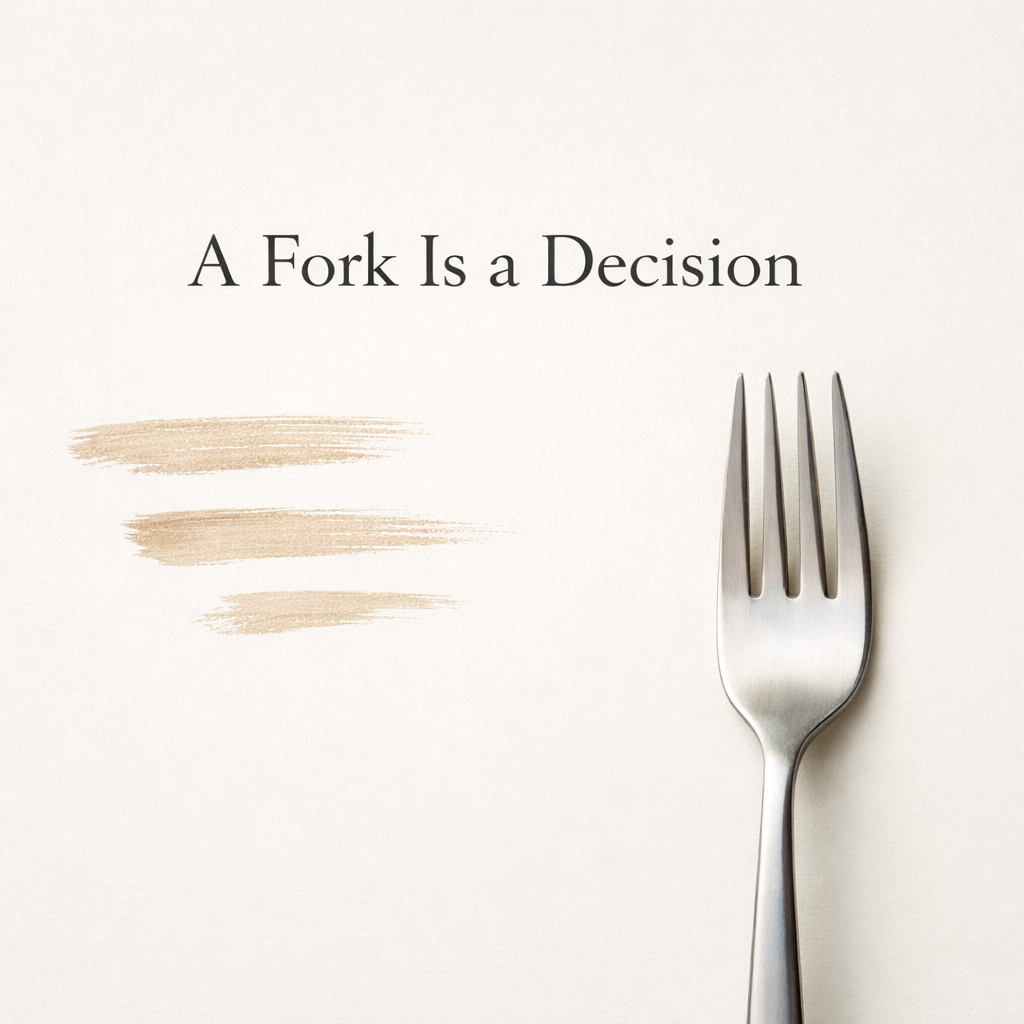
A fork pretends to be neutral.
It isn’t.
The moment you pick it up, you agree to a way of eating. You accept distance. You accept separation. Food becomes something you manage, not something you meet.
We don’t talk about this much because utensils feel inevitable. They aren’t. They’re choices that got normalized long before we arrived at the table.
A fork tells you to divide.
A spoon asks you to gather.
Chopsticks demand attention.
Hands remove all pretense.
None of these are better. But none are innocent.
A fork encourages neatness. It rewards control. It lets you construct perfect bites, regulate texture, avoid mess. It creates a small barrier between body and food. Just enough to keep things polite.
That distance matters.
Think about how differently you eat something depending on what’s in your hand. A curry eaten with a spoon becomes cohesive, blended, intentional. The same dish eaten with bread or fingers becomes tactile. Personal. Slightly risky.
Chopsticks slow you down. Not because they’re inefficient, but because they refuse haste. You can’t rush them without consequences. They make you accountable to each bite.
Hands collapse the performance entirely. There’s no choreography left. No disguise. Eating becomes animal again — temperature, oil, resistance, scent. You feel everything.
In many rooms, a fork is chosen for you.
In some, it’s the only option.
In a few, its absence is the point.
We tend to frame utensil choice as cultural or practical. But it’s also emotional. Psychological. Philosophical.
A fork says: don’t touch.
A spoon says: don’t separate.
Hands say: don’t hide.
This isn’t about authenticity. It’s about awareness.
The utensil you’re given tells you what kind of experience the room wants you to have. Controlled. Comforting. Intimate. Efficient. Performative. Honest.
Even the weight matters. Heavy cutlery signals seriousness. Light cutlery disappears, intentionally or not. Disposable utensils announce impermanence. A lack of utensils invites vulnerability.
A fork can make a dish feel refined.
It can also make it feel distant.
Sometimes food wants to be held. Sometimes it wants to spill. Sometimes it wants to resist being organized.
When a room insists on a fork, it’s often insisting on restraint. When it removes one, it’s asking for trust — from both sides of the table.
The decision happens quietly. Long before the first bite.
You don’t notice it because you were never meant to.
But once you do, you can’t unsee it.
A fork is a decision.